
What is GitHub and how to use it

What is GitHub?


GitHub is a web based Git or a version control repository and internet hosting service. It offers:

  1. Distributed version Control
  2. Source Code Management 
  3. Plans for free and private repositories on the same account
  4. Host Open source software projects
Is a very useful tool for projects, can be accessed and manipulated using the standard git command line interface and all of the standard git commands works with it, github allows registered and not registered users to browse public repositories on the site

it does also provides a social networking function such as:
  1. Feeds
  2. Followers
  3. Wikis
  4. Social network graph

How to use it?

Step 1:

lets go to GitHub


Step 2:
Create an account / Log in


Step 3:

Choose your plan, After you have create an account it will ask you if you want to be a free user or if you want to pay for it
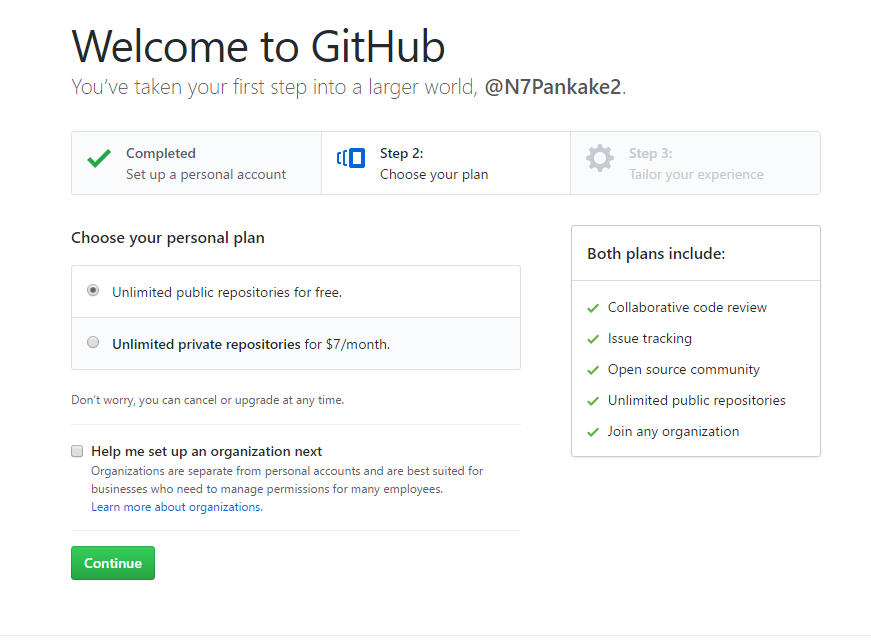


Step 4:

Choose your level of experience


After you finish setting up your GitHub account we will select the option Start a project (Unless you want to read the guide on how does GitHub works)


After you choose to Start a project it will ask you to please confirm your e-mail to keep going


After you have finish doing all the basics to start using GitHub we will create our first repository

Step 5: Creating your own repository

We will go to the right corner of the page


We will click on "New Repository"  and we will give it a Name to that repository and also we will set up if we want to make it public or not.


I have create one as a test so you can see how it will look


We are almost done with the repository now we will add some files to it, click on the buttom that says "Upload files" 


We will drag the files we want to save on our GitHub


Now after dragging the files that you want to upload to your GitHub it would be good to add a description of what you are adding or updating in your GitHub, this is how it will look after uploading the files.


And that's all my friends I hope you find this guide quite useful and by just clicking the file you just upload you can access it with no problem just like this:


Comments

Popular posts from this blog

What is Eclipse IDE and how to install

What is Eclipse? Eclipse is an integrated development environment (IDE) used in computer programming, and is the most widely used Java IDE. It contains a base workspace and an extensible plug-in system for customizing the environment. Eclipse is written mostly in Java and its primary use is for developing Java applications, but it may also be used to develop applications in other programming languages via plug-ins, including  C, C++, Fortran, JavaScript,  and others. Development environments include the Eclipse Java development tools (JDT) for Java and Scala, Eclipse CDT for C/C++, and Eclipse PDT for PHP, among others. How to install Eclipse Step 1: First we are going to download Eclipse at their website, make sure you select the correct OS. Step 2: After you finish downloading it you will get a Zip file with the name of the Eclipse you just download, open it and extract it and after that you are going to run it and this is going to be ...

What is the 'Oracle Virtual Machine' and how to install it

What is the Oracle Virtual Machine? VirtualBox is a powerful x86 and AMD64/Intel64  virtualization  product for enterprise as well as home use. Not only is VirtualBox an extremely feature rich, high performance product for enterprise customers, it is also the only professional solution that is freely available as Open Source Software under the terms of the GNU General Public License. In other words is an emulator for Operative systems, for example if you have a Windows 10 and you want to have Linux or any other without going through all the complicated installation process then you can just install it with the emulator assigning the amount of space and resources that you want to use on it. How to install the Oracle Virtual Machine (OVM)  Step 1: Download the OVM from the main page: Step 2: Select the operating system you are going to be using to host the OVM Step 3:  Install, After you...

If and else statements on Shell/Linux Terminal

If and Else if and else are conditions statement that can be very useful and we are going to learn how to use them, lets first start our terminal and create a file in which we are going to create a simple security password program We are about to create our script I have name it test and we are going to type the following we are going to create a variable called VALID_PASSWORD with the value "secret", this means our password is secret (yes the actual password is secret), then we are going to read the value the user introduce with read PASSWORD the if statement here will compare what the user introduce in PASSWORD with VALID_PASSWORD!, IF they are equal then it will print you have access if not then it will print ACCESS_DENIED! is very important to close the IF statement with an 'FI' (FI closes the IF statement) I hope this was useful and detailed enough to help you understand how does if and else works. to try this all you need is 'bash...